1. The Crisis That Started It All
Picture this. It is late 2008. The news cycle is running at full panic. Bear Stearns (The global investment bank and securities trading firm) has collapsed. Lehman Brothers just filed the largest bankruptcy in American history. Millions of people are watching their savings evaporate, their homes foreclose, their jobs disappear.

The banks had spent years making reckless bets on mortgage backed securities, essentially gambling with other people's money. When the bets went wrong, they did not just lose. They took the whole economy down with them.
And then came the part that made people genuinely furious: the government stepped in and bailed them out. Not with the banks' own money. With the Taxpayer's money. The same people losing their homes were now funding the rescue of the institutions that caused the crash.
It was not just anger. It was a deeper kind of disillusionment. If a government can print money and hand it to failing institutions without anyone's consent, what does that say about the value of money itself? What does it say about trust?
On Halloween night, October 31, 2008, someone (or a group of people, nobody knows for certain) going by the name Satoshi Nakamoto posted a paper to a cryptography mailing list. It was a proposal for a new kind of money that did not need banks, governments, or anyone's trust at all.
The paper was called "Bitcoin: A Peer-to-Peer Electronic Cash System."
2. The Problem with Money
Before getting into what Bitcoin is, it helps to understand what is genuinely broken about the money we already use.
Inflation: When a central bank prints more money, the supply grows but the amount of goods in the economy does not grow at the same rate. So every note in your wallet buys a little less. Over decades, this quietly destroys savings. We could see extremes in Zimbabwe and Venezuela where people needed wheelbarrows of cash to buy bread, but even stable modern currencies experience a slower erosion of purchasing power over time.
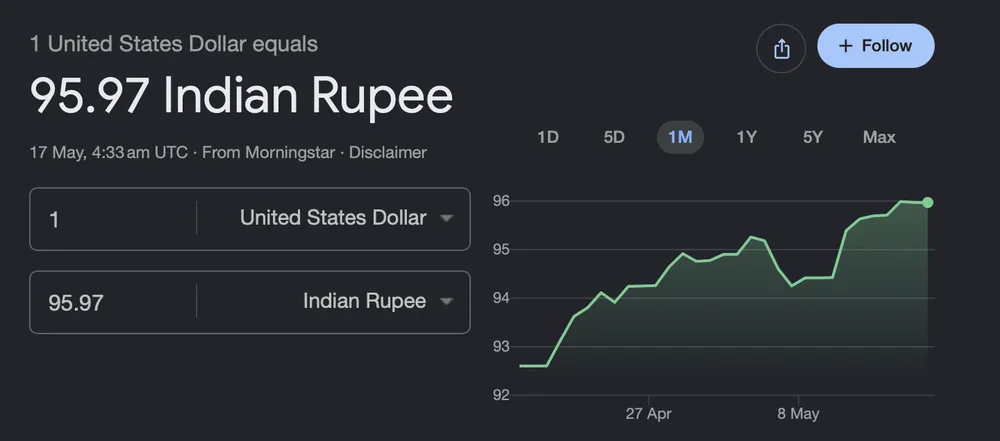
Centralisation: The RBI, the Federal Reserve, the ECB. A tiny group of institutions makes decisions that affect every person who uses their currency, and you have absolutely no say in any of it. Rates, supply, stimulus cheques, bailouts. All decided without you.
Modern currencies are backed by trust, not physical assets. Before 1971, currencies were backed by gold. You could theoretically show up at a bank with your dollars and leave with actual gold.
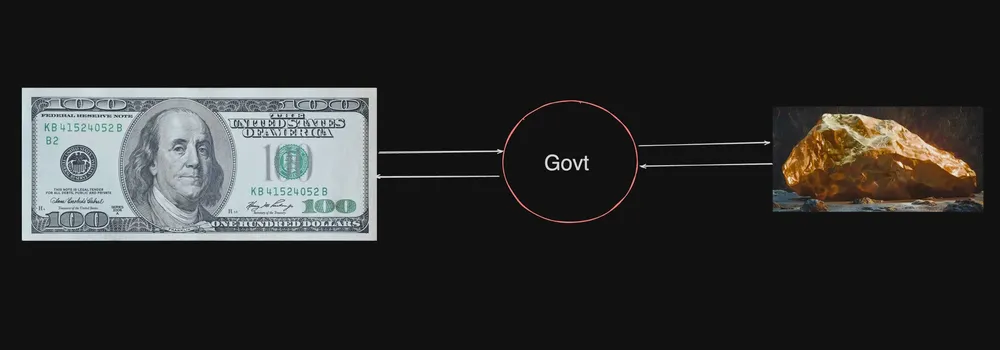
Then U.S. President Richard Nixon ended the gold standard in 1971. Since then, every major currency's value rests entirely on collective belief and government mandate. If enough people stop believing, it is worth nothing.
3. Gold and Why It Stopped Working
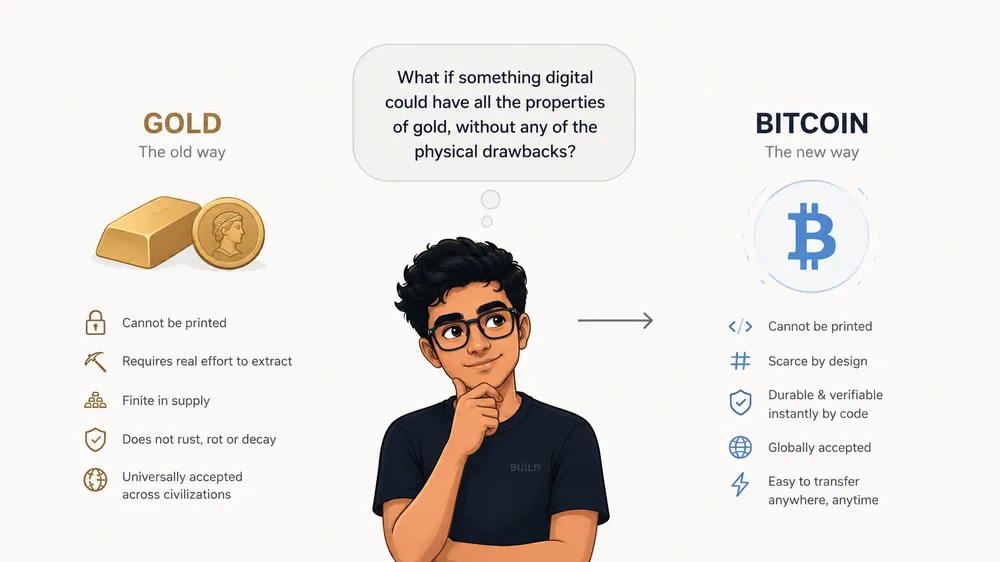
For most of human history, the answer to all of this was gold. And it worked remarkably well, for a remarkably long time.
Gold cannot be printed. It has to be physically pulled out of the earth, which takes real effort and expense. There is a finite amount of it. It does not rust, rot, or decay. A gold coin from ancient Rome is still gold today. Every civilisation across every era has agreed it is valuable.
But gold in the modern world has some obvious problems. It is heavy, It is hard to divide cleanly, Verifying purity requires expert testing, Markets are fragmented: the price differs between Mumbai and New York, and your local jeweller charges 3 to 5% on top just to sell it to you. Moving it across borders is slow and expensive.
So someone had a natural question: what if something digital could have all the same properties as gold, without any of those physical drawbacks? Something scarce by design, durable, globally accepted, and whose purity could be verified instantly by code?
That is exactly what the idea behind bitcoin was.
4. Enter Bitcoin
The software launched on January 3, 2009. The very first block mined on the network, known as the Genesis Block.
For the first year or so, Bitcoin was a curiosity among developers and cryptographers. It had essentially no monetary value. People shared it freely, mined it on laptops, posted about it on forums. The idea was interesting but still entirely theoretical.
Then came the pizza moment.
On May 22, 2010, a developer named Laszlo Hanyecz posted on a Bitcoin forum. He had 10,000 BTC and he wanted to buy a pizza. He offered the bitcoins to anyone who would order him two Papa John's pizzas. A guy in the UK took the deal, ordered the pizzas internationally, and Laszlo sent him the 10,000 BTC.
At the time, those 10,000 BTC were worth about $40.
That transaction mattered more than anyone realised at the time. It was the first time Bitcoin had been used to actually buy something in the real world. It proved the concept.
After that, things started moving. Exchanges began forming. Developers built wallets. Merchants started experimenting. The price, which had been essentially zero, started ticking upward because now there was proof that you could actually use this thing.
May 22 is now celebrated every year as Bitcoin Pizza Day. And those 10,000 BTC? At Bitcoin's all time high of around $126,000 per coin in October 2025, that pizza order would have cost approximately $1.26 billion.
5. The Whitepaper, Broken Down
Satoshi's nine page paper is one of the most consequential technical documents of the 21st century. Here is what it actually says:
The Core Problem It Solved
If you send someone a digital file, they can copy it. That is fine for photos. It is catastrophic for money. If digital cash can be copied, you can "send" the same coin to two different people. This is called the double spend problem, and it is why every earlier attempt at digital money required a central server to keep track of who owns what.
But you do not need a central server if you replace it with a public record that everyone maintains together. Nobody can secretly change their copy, because everyone else's copy would immediately contradict it.
Transactions Are Chains of Signatures
The whitepaper defines a coin as "a chain of digital signatures." When you send Bitcoin to someone, you sign a message with your private key that essentially says "I am the current owner and I am passing this to the next person." That signature and the new owner's public key get attached to the coin's history. Anyone can verify the entire chain of ownership, all the way back to when the coin was first created.
The Timestamp Server
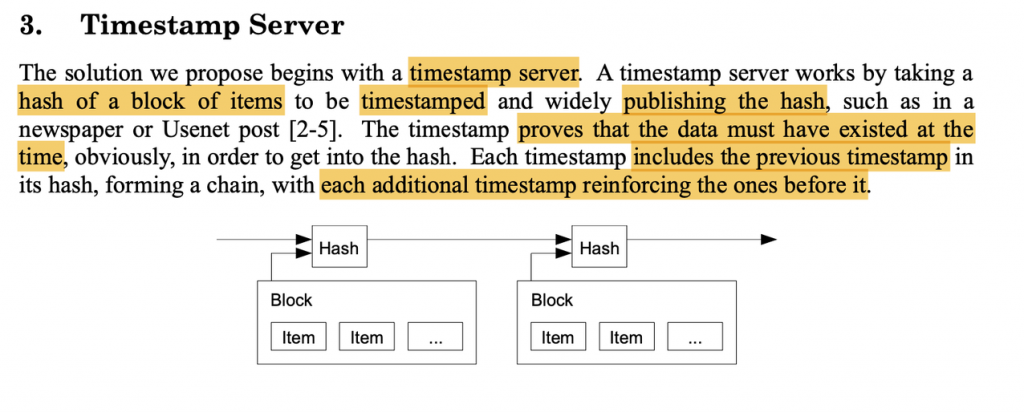
For the public ledger to work, everyone needs to agree on the order of transactions. You cannot have everyone keeping their own version of events and hoping it matches. Satoshi proposed a timestamp server: each batch of transactions gets hashed together, and each new batch includes the hash of the previous one. Change anything in the past and the chain breaks. This is the blockchain.
You can try this in the interactive simulation in the Proof of Work section below. Modify a block and watch the whole chain break.
Merkle Trees
To keep the blockchain from growing unmanageably large, Satoshi introduced Merkle trees. Every transaction in a block gets hashed, those hashes get paired and hashed again, all the way up to a single "root hash". Once old transactions are buried deep enough under subsequent blocks, the transaction data can be pruned away and only the root hash needs to be kept. Satoshi calculated this would only grow at about 4.2 MB per year. Easily manageable.
Lightweight Wallets
Simplified Payment Verification lets mobile wallets check block headers and proofs instead of downloading the full chain.
Privacy Without Anonymity
The ledger is public, but addresses do not automatically reveal real-world identity.
The Security Maths
Section 11 of the whitepaper works out the probability of an attacker successfully rewriting history. The probability drops exponentially as more blocks pile on top. Even an attacker controlling 30% of the entire network's computing power has less than 0.01% chance of rewriting history 24 blocks back. This is why six confirmations became the informal standard for high value Bitcoin transactions.
You can read the full paper here: https://bitcoin.org/bitcoin.pdf
6. The Cryptography Behind It
You do not need to be a cryptographer to understand blockchain, but two concepts matter: hashing and digital signatures.
Hashing
A hash function takes any input and produces a fixed-length string. Think of it as a fingerprint for data. The same input always gives the same output, but you cannot reverse-engineer the input from the output. Change one character, and the hash changes completely.
Input: "Hello, world"

SHA-256: 315f5bdb76d078c43b8ac0064e4a0164612b1fce77c869345bfc94c75894edd3

Input: "Hello, world!"

SHA-256: 3553a64fd8d0e63dcc6f2d1cebfcdfa6b7d4bf0d0c0e3ee8bb8d3e5e32bd0f1f
One exclamation mark. Completely different hash. This is exactly why you cannot quietly edit a block in the blockchain. Change one transaction and the block hash changes, which invalidates every block that points to it.
Asymmetric Encryption and Digital Signatures
Wallets use asymmetric cryptography. A public key is shareable; a private key proves ownership. When you send Bitcoin, you sign the transaction with your private key. The network verifies the signature with your public key without ever seeing the private key.
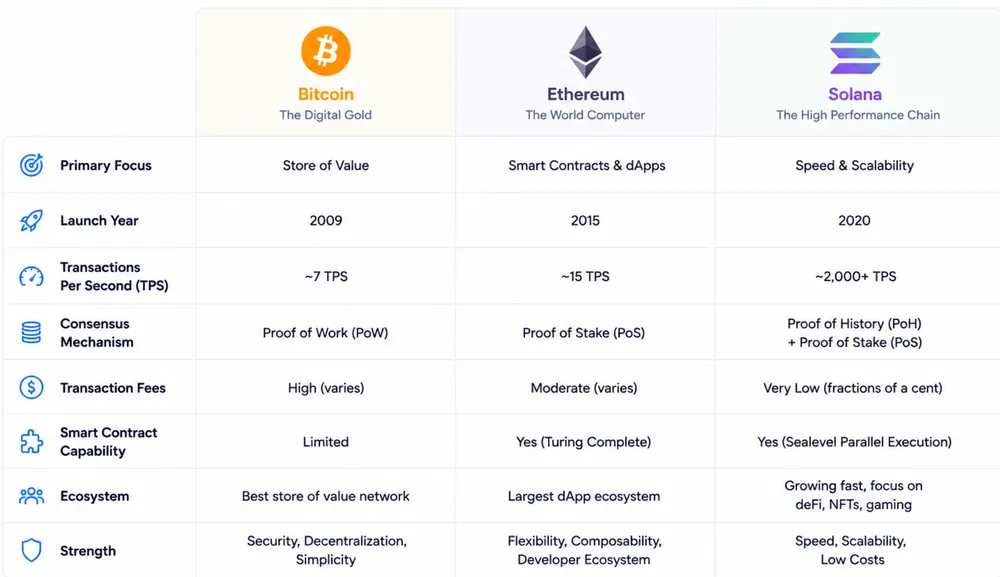
Bitcoin and Ethereum use ECDSA with the secp256k1 elliptic curve. Solana uses EdDSA with ed25519. The names sound exotic, but the principle is familiar: this same family of cryptography protects HTTPS, SSH, and GitHub access.
Visual explainer on how elliptic curve cryptography works: https://www.youtube.com/watch?v=NF1pwjL9-DE
7. How a Blockchain Actually Works
Imagine you want to launch a decentralized currency. You write a program that anyone in the world can download and run. Running it makes a computer a node on the network, a participant in the shared ledger.
- Write the rules into code: total supply, valid transactions, block reward schedule, block time, and signature requirements.
- Let anyone join the peer-to-peer network without permission.
- Users generate public/private key pairs instead of bank accounts.
- To send BTC, a user signs a transaction and broadcasts it.
- Miners verify signatures and collect pending transactions into a candidate block.
- Each block includes the hash of the previous block, chaining history together.
- Nodes accept a new block only if every rule is satisfied.
This repeats roughly every ten minutes on Bitcoin. The chain grows, and every transaction that has ever happened remains publicly recorded.
See live Bitcoin blocks forming right now: https://blockstream.info/
8. Proof of Work: The Puzzle That Secures Everything
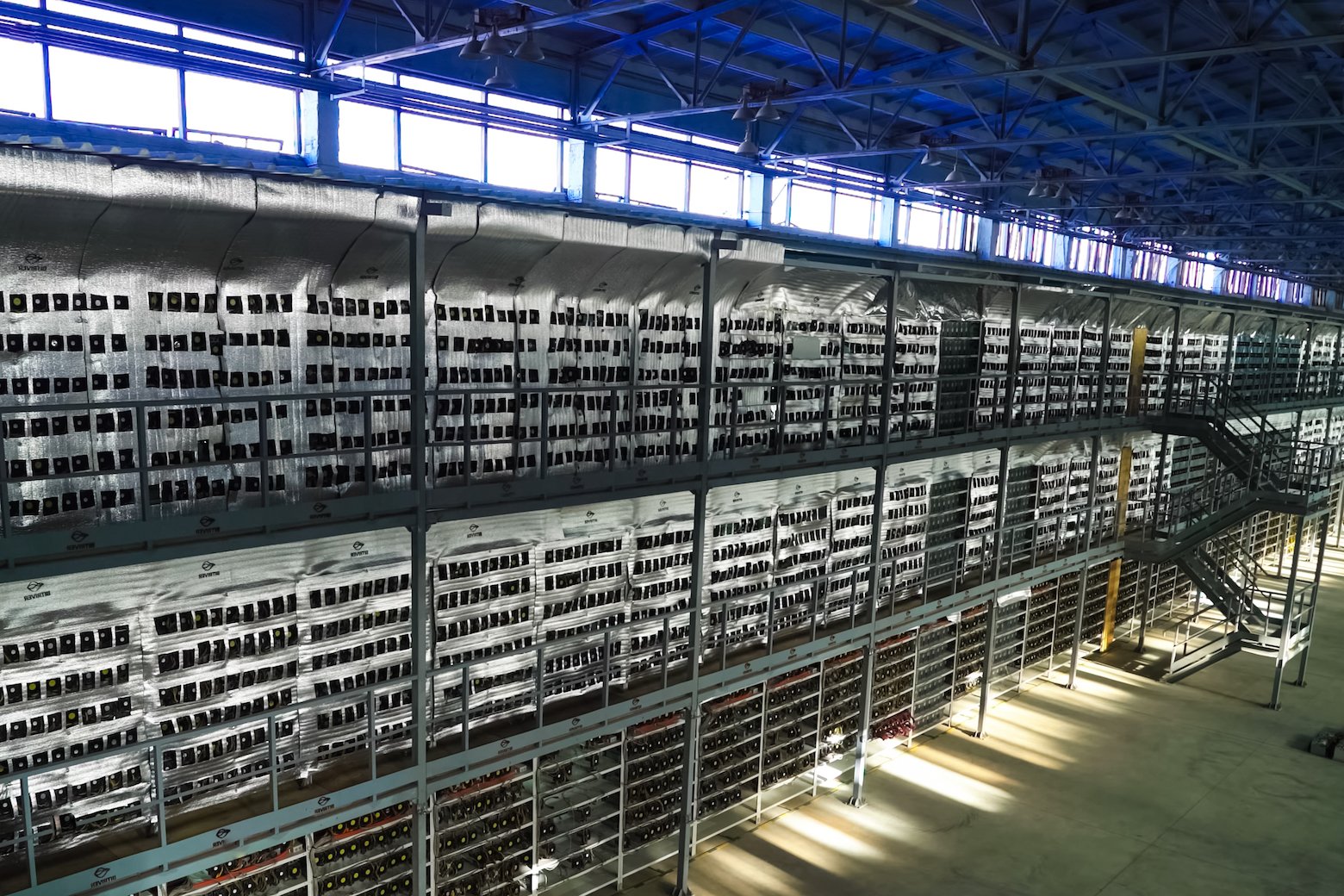
If anyone can try to add a block, what stops someone from writing fraudulent transactions into one? The answer is proof-of-work. Before a miner can add a block, they must solve an expensive puzzle.
The challenge: find a number (called a nonce) such that the block's SHA-256 hash starts with a required number of zeros.
SHA-256("all transactions" + "previous block hash" + nonce)
= 00000000000a1b2c3d...
There is no clever shortcut. Miners try numbers again and again until one works. Bitcoin adjusts the difficulty so a valid block is found roughly every ten minutes, no matter how much mining power joins or leaves.
This is why historical tampering becomes unrealistic. To alter an old block, an attacker must redo the work for that block and every block after it while the honest network continues extending the real chain.